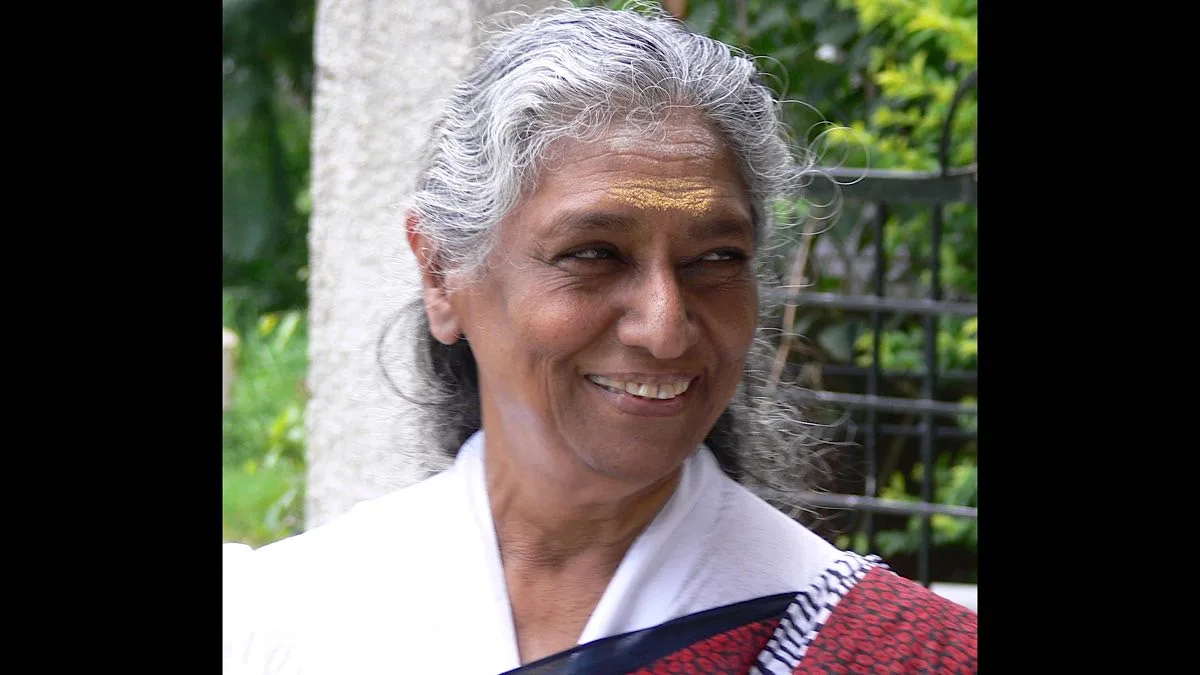
Sistla Sreeramamurthy Janaki , fondly called Janaki Amma and the “Nightingale of South India,” was one of the most prolific, versatile, and influential playback singers in the history of Indian cinema. Over a career spanning more than six decades, she recorded over 48,000 songs in around 20 languages, leaving behind an immortal musical legacy before her passing at age 88.
Born on 23 April 1938 in Repalle, Guntur district, Andhra Pradesh, her native language was Telugu. She absorbed the fundamentals of Carnatic music by tagging along to her elder sister’s music lessons. Under the short-lived guidance of her tutor Paidiswamy, she built a robust foundation that won her second prize in an All India Radio music competition
Advertisement
Driven by her raw talent, she moved to Chennai to find work in cinema, making her debut at age 19 with two songs in the Tamil film Vidhiyin Vilayattu (1957) under composer T. Chalapathi Rao.
Advertisement
What truly set Janaki apart from her peers was her extraordinary ability to act through her microphone, earning her the title “Queen of Expression”. She possessed a chameleonic vocal range. She could effortlessly pivot from the intense sorrow of a grieving mother to a playful, tap-dancing street anthem.
Despite her Telugu roots, her absolute commitment to perfect diction allowed her to flawlessly sing in Kannada, Tamil, Malayalam, Hindi, and several other regional languages. Her partnership with maestro Ilayaraaja produced thousands of timeless classics, such as the hauntingly beautiful “Thumbi Vaa” (Olangal) and “Senthoora Poove” (16 Vayathinile).Her historic duets with S.P. Balasubrahmanyam defined decades of romantic cinema across Telugu, Tamil, and Kannada films.
In the 1980s, she successfully crossed over to Hindi cinema with massive hits like Bappi Lahiri’s disco-infused “Yaar Bina Chain Kahan Re” (Saheb) and the soulful ballad “Dil Mein Ho Tum” (Satyamev Jayate).
She secured a monumental 33 State Film Awards across Kerala, Tamil Nadu, Andhra Pradesh, and Karnataka. She was Conferred with an honorary doctorate from the University of Mysore
S. Janaki captured the hearts of people of Kerala by becoming the literal soundtrack to their everyday lives. While she was musically brilliant, her connection with the state went far deeper than just chart-topping hits—she embedded her voice into the most intimate, emotional, and cultural moments of the Malayali identity.
Janaki became a maternal figure in every Malayali household through her unmatched delivery of lullabies (Tharattu Pattukal). When she sang “Thumbi Vaa” (Olangal) or “Allimalarkkavil” (Midhunam), her voice possessed a soothing, breathing quality that felt like a mother comforting a child
Kerala’s culture is deeply tied to its lush monsoons, backwaters, and village life. Janaki had a supernatural ability to reflect this imagery in her singing. Her voice sounded like the rains, the rustling coconut palms, and the mist-laden hills of the state. Tracks like “Mizhiyoram Nananjozhukum” (Manjil Virinja Pookkal) felt like a rainy evening in Kerala, making her music an inseparable part of the state’s geography and mood.
The people of Kerala historically value simplicity and intellectual depth over Bollywood-style glamour. Janaki’s personal persona perfectly mirrored these values. She always appeared in public wearing simple traditional sarees, a traditional bindi (pottu), and a warm, maternal smile.
She stayed completely away from controversies, lived a quiet life, and treated her monumental talent as a humble divine gift. This lack of pretense made her deeply relatable to the common man in Kerala.
Kerala Chief Minister VD Satheesan paid tribute to the late singer S Janaki on Facebook, calling her the finest personality in South Indian film music history. He highlighted how her extraordinary voice masterfully captured and immortalised deep human emotions, including love, joy, and devotion, in an entirely unique manner.
Representing the Kerala government, Higher Education Minister Roji M. John paid final tributes to legendary singer S. Janaki. He placed a wreath at her public homage ceremony held at the Maharaja’s Ground in Mysore.
Advertisement